“Marilyn, that icon of über-femininity, is most often compared to other dead women. Or rather, other dead women are compared to her … Whenever a glamorous young woman dies, she is compared to Marilyn Monroe, whether she was a blonde – or dumb – or not.” – Sarah Churchwell
“Like many women, I’ve been studying Marilyn Monroe my entire life,” Karina Longworth writes in the notes for her podcast, You Must Remember This. After making her name in the blogosphere, Longworth has published studies of contemporary movie icons including Meryl Streep.
No less than three classic Monroe films (Bus Stop, Some Like It Hot, and The Misfits) are featured in Hollywood Frame by Frame, a book of contact sheets for which Longworth supplied the text. Since 2014, she has been exploring Hollywood history in her popular and influential podcast. A trilogy of episodes about Marilyn’s life and death is the centrepiece of a dedicated series, ‘Dead Blondes’, and her marriage to Arthur Miller was profiled in an earlier season, ‘The Blacklist.’
In this pantheon of dead blondes, Marilyn is preceded by Peg Entwhistle, Thelma Todd, Jean Harlow, Veronica Lake and Carole Landis; and her successors include Jayne Mansfield, Barbara Payton, Grace Kelly, Barbara Loden and Dorothy Stratten. “The title is a little bit tongue-in-cheek, but it’s also incredibly literal,” Longworth told Entertainment Weekly. “There does seem to be this fascination in the wider culture with these quote-unquote ‘perfect victims,’ the beautiful woman who is taken too soon.”
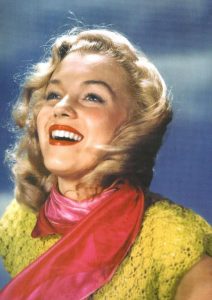

In a decade characterised by material pleasures and sexual repression, curvaceous Marilyn represented ‘a feminine icon of plenty’, but in private, she was plagued by miscarriages and endometriosis. Ezra Goodman, in his The Fifty Year Decline and Fall of Hollywood, described her, and the blonde bombshells who followed in her wake, as ‘lost souls’ whose malleable personae mirrored post-war America’s identity crisis. In ‘Marilyn Monroe: The Persona’, Longworth focuses on her initial starring roles. She gave an affecting performance in Don’t Bother to Knock, an overlooked drama which Longworth judges “both terrifying and sympathetic in its sexualised portrait of female hysteria.”
This was followed by “a trilogy of parodies of consumerism”, starting with Niagara (1953), in which she plays the libidinous Rose, her only character to die onscreen. Although Rose is herself an accessory to murder, Longworth finds her death “legitimately sad – but sadness doesn’t sell.” After Gentlemen Prefer Blondes, Marilyn would be more often identified with comedic parts. Lorelei Lee, Longworth argues, was “the smartest of [Monroe’s] dumb blondes”, justifying her lust for diamonds and manipulation of men as essential self-protection. Blondes was also her first major musical, in which, alongside co-star Jane Russell, she mastered “acting in song.” How to Marry a Millionaire took a more critical view of the selfish society, but is also less cynical as the gold-diggers finally choose love.
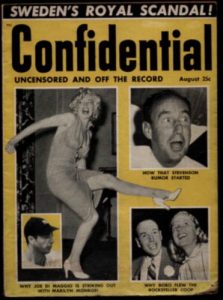

Longworth believes that incidents like the broken strap at Marilyn’s 1956 press conference with Sir Laurence Olivier were “highly calculated”, and by the time she was filming The Prince and the Showgirl in England, Olivier apparently shared that view. Newly married to Arthur Miller, and under the spell of the Strasbergs and psychoanalysis, Marilyn was also dependent on sleeping pills, and the doctors who prescribed them.
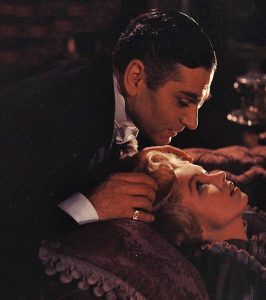

Miller famously did not ‘name names’, and was estranged from Kazan. By the time of his acquittal in 1958, Marilyn was filming Some Like It Hot. Her problems on the set are well-documented, but it would become her most enduringly popular movie. Playing the “dumbest of blondes”, Longworth remarks that she “had nothing ‘mental’ to work with.” Her next film, Let’s Make Love, was notable mainly for her affair with co-star Yves Montand. After hearing the gossip, Kazan approached Miller and they began working on After the Fall, a play which draw heavily on his troubled marriage, and would open at the Lincoln Center, which the two men co-founded, in 1964.
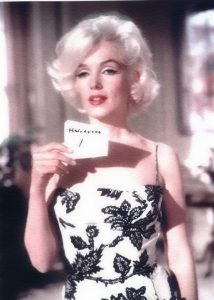

Karina Longworth is an accomplished storyteller and perceptive critic, but her research is not impeccable. Her main sources are biographies by Donald Spoto, Gloria Steinem and Lois Banner. Although she takes a mostly sympathetic, even feminist view, she is not immune to sensationalism and once posted – but later deleted – Marilyn’s autopsy photo on Twitter to promote the show (it was first published, amid much disquiet, in Anthony Summers’ Goddess.) She occasionally misattributes quotations, or conflates different events, which can give a misleading impression. For example, while the young Norma Jeane may have fantasised that her father was Clark Gable, there is no evidence that she actually believed this, or told it to others. And the 113-ft ‘longest walk in history’ in Niagara was not Marilyn’s death scene. If Longworth’s aim is to demythologise the Monroe legend, she doesn’t fully succeed. Although You Must Remember This offers a lively analysis of the star system, it shouldn’t be taken too literally but rather as a starting point for further exploration.
Tara Hanks for Immortal Marilyn